
Why we run a network we don't own.
Private practice can be lonely. The Kwinana and Rockingham Mental Health Professionals Network brings local practitioners into the same room.
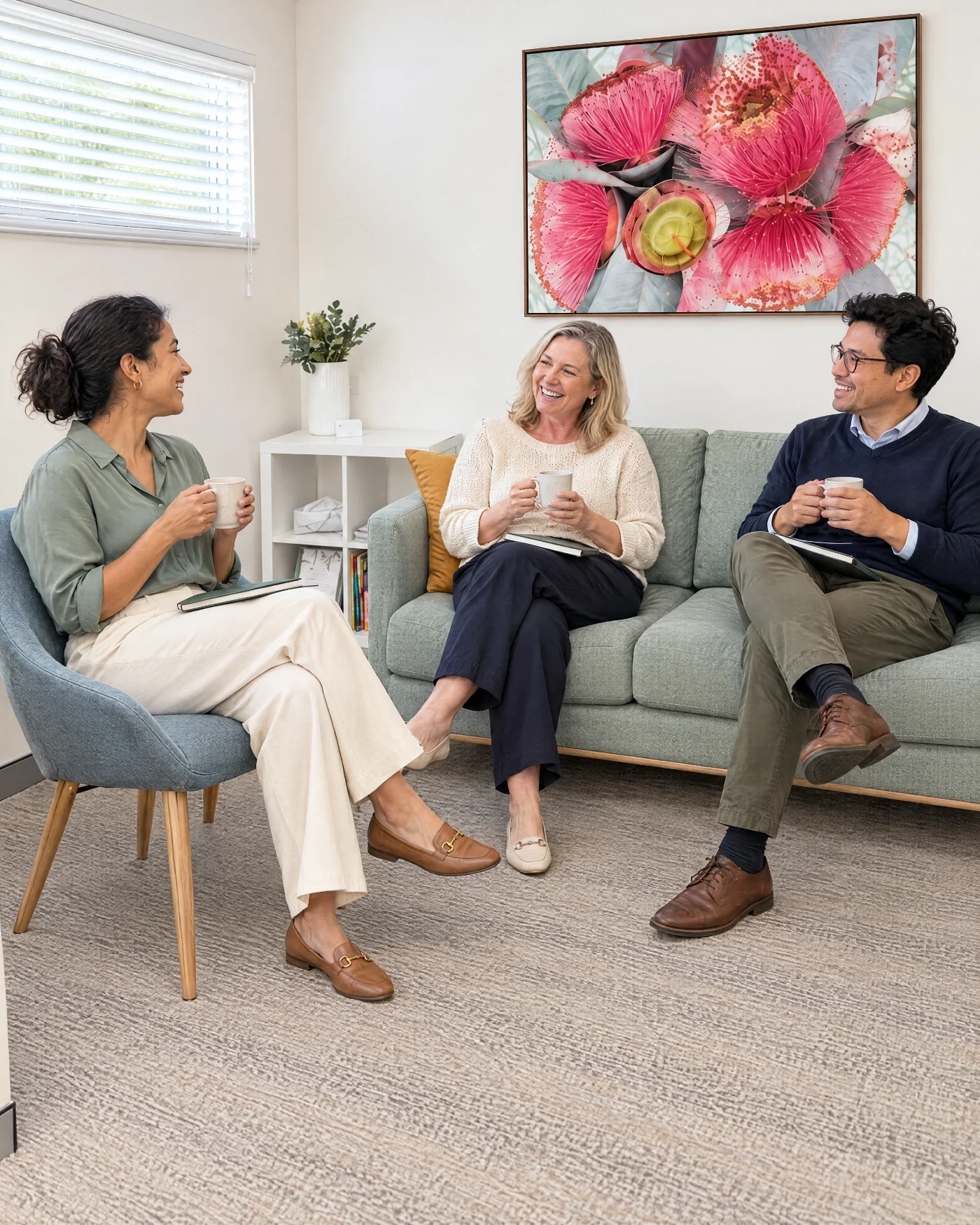
Private practice is a strange kind of lonely. You can see six people in a day, hold the hardest hours of their year, and still finish the week having spoken to almost no one who does what you do.
That isolation shows up in the work. A clinician with no one to think alongside makes narrower decisions. A clinician who does not know who else is out there refers from a directory, not from knowledge. And a profession where people struggle quietly in separate rooms loses good people.
That is the problem the Mental Health Professionals' Network (MHPN) exists to solve, and why we helped start a local one.
What MHPN is
MHPN is a national initiative funded by the Australian Government. It supports local networks of mental health practitioners around Australia, and it is free for practitioners to join.
The idea is simple. Practitioners from different disciplines in the same area meet regularly, learn something together, and get to know one another.
Our local network
Andrea Groom co-founded the Kwinana and Rockingham Mental Health Professionals Network. It ran its first event in March 2026, with Jackie Wickham, who now facilitates it. It meets monthly, with a professional development topic each time.
- Who it is for: anyone working in mental health in the Kwinana and Rockingham area, including psychologists, OTs, social workers, GPs, nurses, counsellors, dietitians and peer workers.
- How often: monthly, with a learning topic each time.
- Cost: free.
- Facilitator: Jackie Wickham.
Why we give time to it
We do not own MHPN, we do not charge for it, and the network is open to practitioners who are, on paper, our competitors. We do not think of it that way.
The southern corridor does not have too many mental health clinicians. It has waiting lists. What matters is whether there are enough of us, whether we stay in the work, and whether we know each other well enough to hand someone on properly.
Referring well is a relationship, not a lookup. When we suggest an occupational therapist, we want that to mean I know how she works and I think you two will get on, not here is a name from a list. You only get that from sitting in rooms together.
What it means for you
Mostly, it means the care around you joins up without you having to manage it. For many people, the exhausting part of getting help is not the therapy. It is the coordination: repeating your story to five people, chasing referrals, working out who does what. Anything that shifts that load off you is worth doing.
For practitioners
You are welcome, whatever your discipline and however long you have been practising. Newly registered practitioners are often the most isolated. If that is you, come anyway.
Email Jackie Wickham at [email protected], or find the network through MHPN.
Where do I start?
Fill in one short form, or call us. Our care team will help you choose the right person.